
Unbroken | AWE 2026
Unbroken explores the ways music carries memory across generations. Much of the first half of the programme is rooted in inherited voices: medieval chant, Bach, birdsong, folk melody, personal recollection and stories passed from one generation to the next. Each work begins with something older than itself, reshaping it through a contemporary imagination. By the time we arrive at Gideon Klein's String Trio, that chain of inheritance feels both precious and precarious. The programme's second half then turns back further to Antonín Dvořák, whose Piano Quartet stands as a nineteenth century celebration of Czech musical identity, showing the traditions that Klein inherited still alive and flourishing on the international stage.
We begin with our Composer in Residence Michael Norris's Prolation Canon on a Theme by Hildegard von Bingen, for spatialised string quartet, an old thing taken to the modern day. Hildegard was a twelfth-century polymath: abbess, visionary, composer, one of the first people we can name as a composer at all. "Prolation" is an old, now obsolete word for the act of speaking or uttering; in music it survives only as a technical term, describing the time relationship between a long note and the shorter notes it breaks into. The same material is staggered across the space of the room, catching up with and overtaking itself, much as Hildegard's voice still catches up with ours across nine centuries.
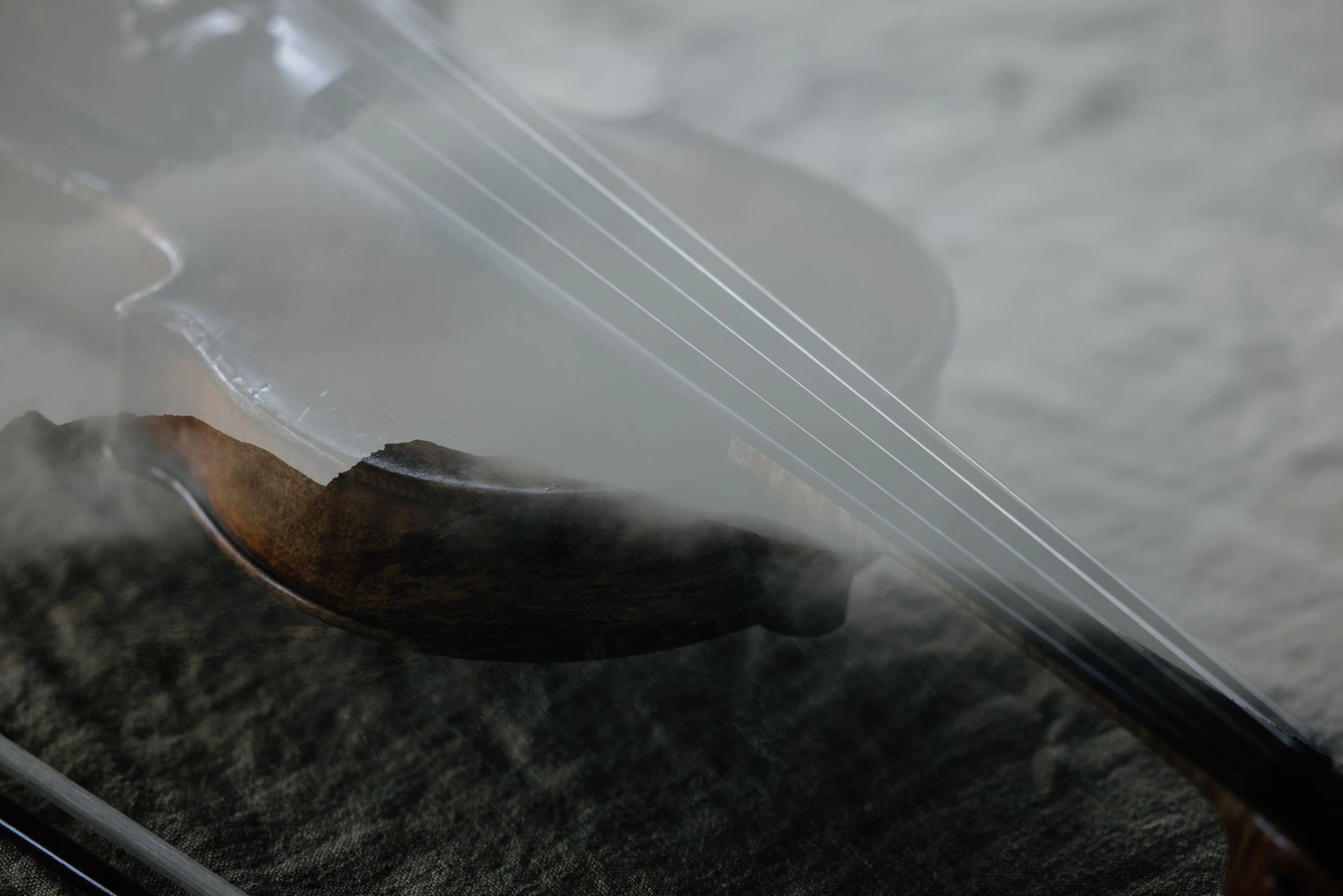
From there to a very special AWE Commission: Sebastian Black's Aitken's Violin, for solo violin. The piece takes its name and inspiration from Dunedin soldier Alexander Aitken, later a renowned mathematician who worked on the Enigma project. Aitken, with his unit, carried a violin, won in an onboard raffle and considered contraband at the front, through Gallipoli and the Western Front, playing for his fellow soldiers in the darkest of times. It was something of a boomerang instrument having twice been thought lost on the front yet both times eventually returned to him, its case covered in the signatures of all those who had carried it.
Black's piece frames one war against another, with the modern world sitting in between: an attempt to imagine an experience we can never fully know, and to let that imagining shape how we listen. Aitken’s Violin was first performed in London this year in the historic clock tower atop St Pancras Train Station. It makes its Aotearoa debut in another venue steeped in history, Bannockburn’s Coronation Hall which was built only a few years before the violin came into Aitken’s possession and at a time when he would have been honing his musical skills at Otago Boys High School.
We turn next to a completely new line: a work for string quartet by Rafael Hosking, our AWE 2026 Emerging Composer. Working alongside Michael Norris, Raf has been gathering field recordings of riroriro (grey warbler) calls from across Aotearoa, transcribing their melodies before fragmenting, extending, and reimagining them for four strings. This is a new line in a longstanding tradition of New Zealand composers who have turned to birdsong for inspiration, and draws deeply on the string quartet's lyricism.
Michael Norris returns with Time Dance, originally conceived in collaboration with choreographer and director Daniel Belton as a live score for dance, and later reimagined in this chamber version for two violins, cello and piano. Taking Bach's Orchestral Suite No. 2 as its starting point, the work dismantles and reassembles Bach's music, allowing it to surface in fragments, echoes and fleeting recognitions. Time seems to stretch and fold back on itself as Bach repeatedly appears, disappears and reconnects in unexpected ways. Rather than quoting the past, Norris invites us to experience it through the imperfect lens of memory, making audible both what endures and what is inevitably reshaped.
And so to Gideon Klein's String Trio, a compact, deceptively light-footed piece in the tradition of folk dances and folk melodies reimagined through a developing modernist language. Klein completed it on 7 October 1944, in the Terezín ghetto, a matter of days before his deportation to Auschwitz and, from there, to Fürstengrube, where he was murdered at 25. The outer movements have all the brightness of Czech country dances; the slow movement at its centre sets a Moravian folk tune his nanny once sang to him. Knowing what we know of Klein’s story, it’s impossible to hear this piece as only music. It’s also, unavoidably, a question: what remains, when a life is cut off mid-sentence?
We close with Antonín Dvořák's Piano Quartet in E-flat major, Op. 87, written in 1889 during one of the most fertile stretches of his life, at his publisher's insistent urging. Dvořák was, more than almost anyone, the composer who took folk material, Bohemian dances, gypsy inflections, the sousedská, the mazurka, and folded it into the chamber music tradition, preserving it and making it new at once - cast your mind back to AWE 2023! Where Klein's line was broken, Dvořák's carried forward, gathering the past into his own hands and passing it on unbroken.