
Crossed | AWE 2026
AWE 2026 launches in Wānaka under the timber trusses of Rippon Hall. In this wonderful space, we begin our exploration of lines with Crossed, a programme that takes us through time into moments where moral, political and spiritual lines are tested, crossed and redrawn.
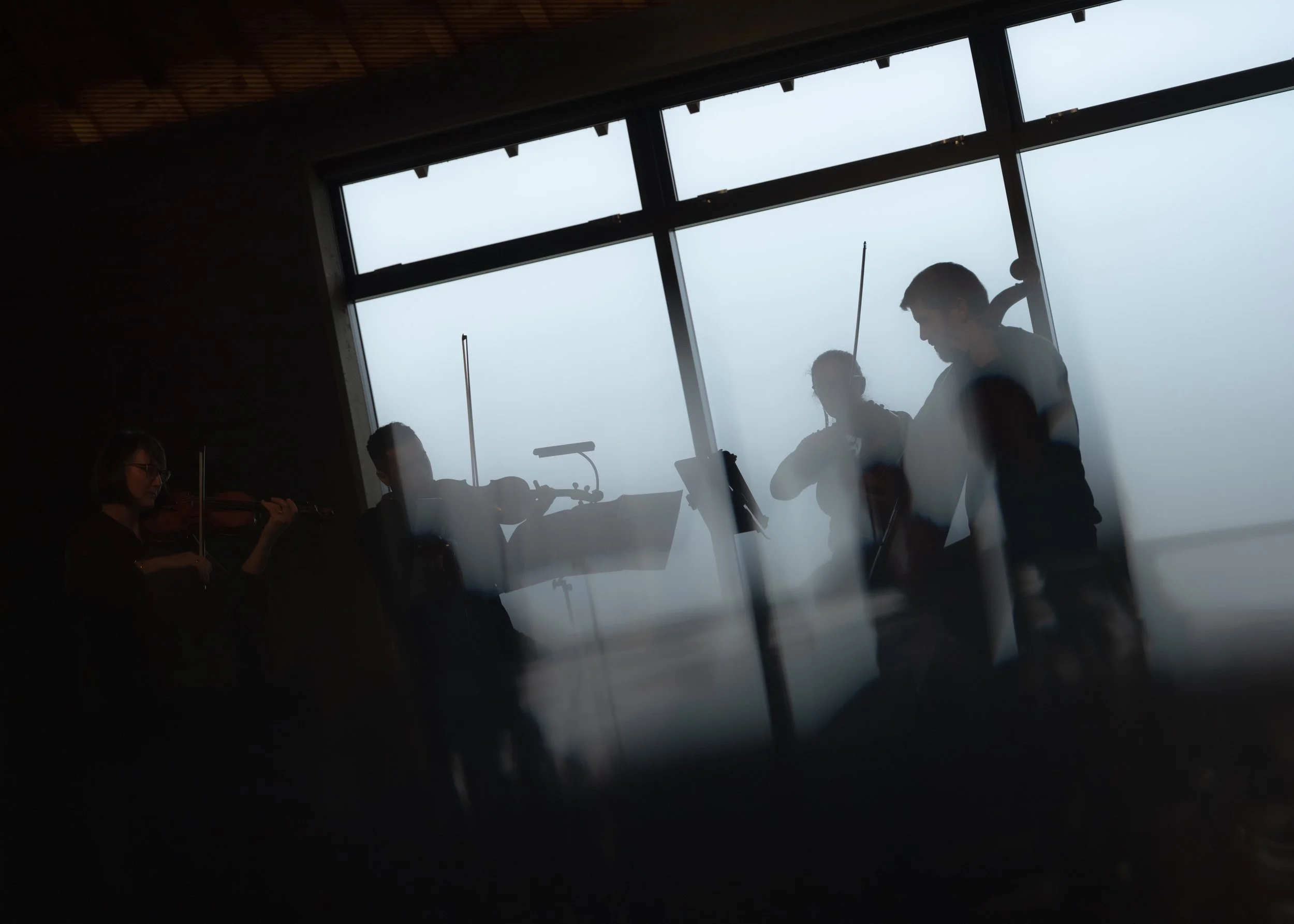
Crossed opens with Grażyna Bacewicz’s Quartet for Four Violins. Bacewicz has become something of a belatedly recognised trailblazer; while celebrated in Poland during her lifetime, the cultural constraints of living under the Iron curtain meant it was only years later that her music was performed on international stages.. In the words of AWE’s co-founder, Benjamin Baker, “to write a quartet for four violins is either genius or foolhardy - with Bacewicz, it is definitely the former!” This quartet was written in 1949, a point in time (particularly so in Poland) when people were trying to redefine themselves and the world around them after the chaos of the previous decade. With Bacewicz’s quartet, we hear a unique voice finding itself as it pushes against convention, with two violins replacing the viola and cello in the traditional string quartet setup, Bacewicz's quartet celebrates the idea of personal liberty through four equal voices with four equal instruments.
From a nation redefining itself and finding expression in new forms, we travel back in time to Bach and one of the purest musical expressions of line: the chorale. Most of the lines that Bach used in his chorales were Lutheran hymn tunes from the 15th & 16th centuries that Bach arranged and added his own unique and distinctive harmonisation. These harmonisations reinforced the foundations of counterpoint: how voices interact in a homophonic way with an extraordinary equality and simplicity where all four musical voices sing the same text, with one note per harmony. When put like that, it can seem an incredibly simple form and in many ways it is, yet it’s also an intricate exploration of how voices move and interact with each other, moving towards and away from one another while remaining completely distinct.
This particular chorale felt like the perfect way in which to introduce this year’s Composer in Residence, Michael Norris, and his own chorale Exitus, III. Niflheim (“The House of Mists”). Michael’s work draws inspiration from Norwegian hymns and Norse mythology, taking ancient chorale and bringing it into the modern world through his own musical language. Like Bach and Bacewicz before him, there’s a familiar structure that’s reworked and reinterpreted, crossing the lines of time, countries and tradition. In Norse mythology, Niflheim is a far northern region of icy fogs and mists, darkness and cold; we are very excited to hear this performed in a far southern region of long white clouds and incomparable light!
We cross back in time once more for our final performance: Beethoven’s String Quartet in C major, op.59, no.3, one of three quartets commissioned by Count Andreas Razumovsky, a Russian diplomat. At the time of their publication, the quartets were received with considerable reservation as they did not seem to conform to the established expectations of the string quartet genre. These quartets were written on the heels of Beethoven’s Eroica Symphony which was dedicated to Napoleon, whom Beethoven admired during Napoleon’s anti-imperialist days. This warmth unsurprisingly evaporated when Napoleon declared himself Emperor, at which point Beethoven violently scratched out his name in the dedication! Much like Bacewicz almost a century and a half later, Beethoven’s works were written in challenging times, those moments throughout the ages in which perspectives change and moral lines are redrawn. What we see throughout Crossed is how these shifting outlooks can provide creative opportunities and the desire to push back against that which we have known and redefine it on our own terms.